
Unpaid Invoices: How to Protect Your Cash Flow and Minimise Losses
15/10/2026 - Published by : FiduPress < Back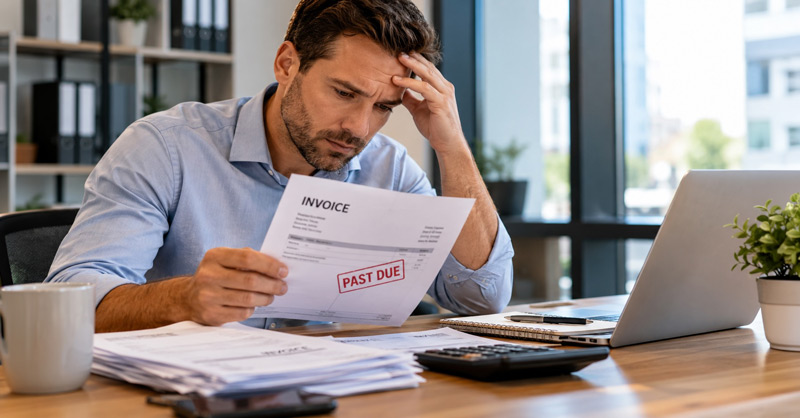
Issuing an invoice does not necessarily mean getting paid. For self-employed professionals and businesses, late payments can quickly put cash flow under pressure, particularly when substantial amounts are involved.
Fortunately, Belgian legislation provides several mechanisms to recover outstanding amounts or, when recovery is no longer possible, to limit the financial and tax consequences.
The key is to act promptly and understand the applicable rules.
Payment deadlines are regulated by law
In commercial transactions between businesses (B2B), the statutory payment period is generally 30 calendar days when no specific deadline has been agreed.
The parties may contractually agree on a different payment period, but this cannot, in principle, exceed 60 calendar days.
When a business customer fails to meet the payment deadline, late payment interest may become payable automatically, without the need for a prior formal notice.
For the second half of 2026, the statutory interest rate applicable to late payments in commercial transactions is 10.5% per year.
Creditors are also generally entitled to fixed compensation of €40 to cover recovery costs. Additional reasonable recovery expenses may also be claimed, subject to the applicable legal requirements.
These provisions provide an additional incentive for businesses to respect payment deadlines.
Acting quickly can prevent bigger problems
When an invoice remains unpaid, the first step is usually to contact the customer.
An administrative oversight, a misplaced invoice or temporary cash flow difficulties may explain the delay.
If this initial contact produces no result, a formal notice of default can be issued, reminding the debtor of their obligations and setting a final payment deadline.
It is essential to retain invoices, email correspondence, payment reminders and any acknowledgements of debt.
These documents may prove crucial if formal recovery proceedings become necessary.
Recovering a debt without going to court
Since 2016, Belgium has provided a specific procedure for the recovery of undisputed monetary debts between businesses.
Under certain conditions, this procedure allows companies to recover outstanding professional debts without immediately initiating traditional court proceedings.
The involvement of both a lawyer and a judicial officer is required.
The debtor has one month to respond to the formal payment demand.
If the debt is validly disputed, the procedure ends, and the matter may need to be referred to court.
However, if the debtor neither pays nor disputes the claim, the procedure may result in an enforceable title, allowing compulsory debt recovery.
This mechanism applies to eligible debts between businesses and cannot be used to recover private debts owed by consumers.
Unpaid invoices also have tax implications
When a business believes that an invoice may never be paid, the accounting treatment of the receivable must also be examined.
Two situations should be distinguished.
Doubtful receivables
Payment remains possible, but recovery has become uncertain.
The business may recognise an impairment loss corresponding to the estimated amount at risk.
This impairment may also be tax-deductible when the statutory conditions are met, particularly when the risk of loss is specifically identified and properly documented.
Definitively irrecoverable receivables
When the loss becomes certain and definitive, the receivable may be written off.
Such losses are generally tax-deductible, provided that their definitive nature can be demonstrated.
The mere fact that an invoice remains unpaid is therefore insufficient to automatically classify it as irrecoverable.
What happens to VAT already paid?
This is an aspect that businesses frequently overlook.
A company may have issued an invoice, declared the corresponding VAT and paid that VAT to the tax authorities, even though the customer has never settled the invoice.
When the legal conditions are satisfied, VAT relating to a definitively irrecoverable receivable may be recovered.
Specific rules apply in certain circumstances, particularly when the debtor has been declared bankrupt.
It is therefore important to determine which supporting documents are required and when the right to a VAT refund arises.
Be aware of limitation periods
Contrary to a common misconception, not all invoices become time-barred after five years.
In Belgium, the general limitation period for contractual claims between businesses is 10 years.
However, shorter limitation periods apply to certain categories of debts, including some recurring payment obligations.
It is also important to understand that an ordinary payment reminder generally does not interrupt the limitation period.
Waiting too long may therefore permanently jeopardise the possibility of recovering an outstanding debt.
Consumers benefit from additional protection
Different rules apply when the debtor is a consumer.
Since September 2023, Belgian legislation has imposed stricter requirements on the amicable recovery of consumer debts.
In particular, the first payment reminder must be free of charge, and a statutory period of 14 days must be respected before certain charges can be imposed.
Interest and compensation are also subject to statutory limits.
Businesses that invoice both professional customers and private individuals must therefore adapt their general terms and conditions and debt recovery procedures accordingly.
Prevention is better than recovery
The most effective way to reduce unpaid invoices is to maintain rigorous accounts receivable management.
Appropriate general terms and conditions, clearly defined payment deadlines, regular monitoring of outstanding balances and prompt reminders can significantly reduce the risk of non-payment.
Automating invoice follow-up can also help identify overdue payments earlier and prevent outstanding receivables from being overlooked.
An unpaid invoice is not necessarily a lost invoice. However, the longer a business waits to take action, the lower its chances of recovering the money may become.
Your accountant can assist you in assessing doubtful receivables, determining their appropriate tax treatment and recovering VAT where applicable.
Back