
You book an electric car… but a petrol car shows up: what happens to your tax deduction?
16/09/2026 - Published by : FiduPress < Back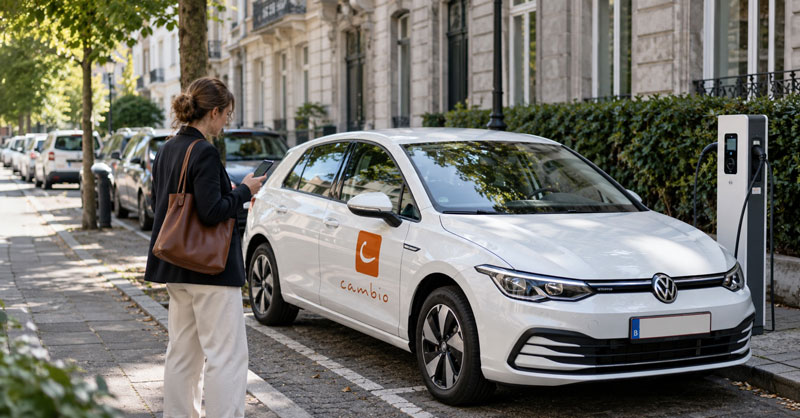
With Belgium’s increasingly strict car taxation rules, businesses and self-employed professionals are facing a very practical question: what happens when the shared car you actually use turns out not to be electric?
For example, you book an electric vehicle with Cambio, but ultimately make the journey in a petrol car.
From a tax perspective, this can make a significant difference.
With car sharing, the vehicle actually used matters
Car-sharing costs directly related to a journey are treated as car expenses for tax purposes.
This means that the characteristics of the vehicle actually used must be taken into account: its powertrain, CO₂ emissions and, particularly since 2026, the date on which the vehicle was acquired by the operator.
This is why Cambio now provides the necessary tax information for each journey on its professional invoices.
A recent combustion-engine car can be expensive from a tax perspective
For a company, the situation in 2026 can be summarised as follows.
An electric car acquired in 2026 remains 100% tax deductible.
For a petrol, diesel or hybrid vehicle acquired from 1 January 2026 onwards, the related expenses are, in principle, no longer tax deductible.
Combustion-engine vehicles acquired between 1 July 2023 and 31 December 2025 still benefit from the transitional regime. Their deduction is calculated according to the CO₂ formula, with a maximum deduction of 50% in 2026 and 25% in 2027. From 2028 onwards, the deduction disappears entirely.
Vehicles acquired before 1 July 2023 remain subject to the previous tax regime, which takes into account, among other factors, their CO₂ emissions.
A very practical example
Suppose your company regularly uses Cambio for business travel.
Whenever possible, you choose electric vehicles. A journey made with an electric vehicle acquired in 2026 can qualify for a 100% tax deduction.
However, if another journey is made with a petrol car that was only added to Cambio’s fleet in 2026, the variable costs relating to that journey may become entirely non-deductible for tax purposes.
It is therefore no longer simply your decision to use car sharing that matters: the actual vehicle used for each individual journey becomes relevant accounting and tax information.
What about taxis and Uber?
Some caution is required here. The same conclusion should not automatically be applied to journeys made by taxi or through a platform such as Uber.
Professional taxi expenses have historically benefited from an administrative tolerance allowing a 75% tax deduction.
The tax treatment of the customer paying for a taxi journey should therefore not simply be confused with the tax treatment of the vehicle used by the taxi operator or driver.
It would consequently be too broad to automatically conclude that a journey made in 2026 using a recently acquired petrol or diesel taxi or Uber vehicle becomes entirely non-deductible for the professional customer.
The invoice becomes essential
For car sharing, accounting software will increasingly need to be able to apply different tax treatments within the same invoice.
Cambio therefore provides information such as the vehicle’s CO₂ emissions and acquisition date for each journey, including through its electronic invoices.
A single invoice could therefore contain:
- an electric journey that is 100% tax deductible;
- a journey with a combustion-engine vehicle that still benefits from the transitional regime;
- and potentially a journey with a combustion-engine vehicle that is entirely non-deductible.
Applying one single deduction percentage to the entire invoice is therefore becoming increasingly difficult to justify.
And what about VAT?
VAT is governed by a separate set of rules.
For car sharing, VAT deductibility remains linked to the professional use of the vehicle and is, in principle, limited to a maximum of 50%.
The deductibility of an expense for income tax purposes should therefore not be confused with the right to deduct VAT.
In practice
The reform of Belgian car taxation therefore has consequences that extend far beyond company cars that are purchased or leased.
New forms of mobility are affected as well.
For businesses and self-employed professionals who regularly use car-sharing services, a new habit is becoming essential: do not look only at the total amount of the invoice, but also at the vehicle to which each individual journey relates.
Because from now on, a few grams of CO₂, or simply the date on which a vehicle was acquired, can make a significant difference to your tax bill.
Back